In today`s world, where energy efficiency is crucial, the concept of Passive House stands out. But exactly what is Passive House?
Curious? Let`s dive-in…
Why the World needs the Passive House Standard?
Image 1 shows that 17,5% of the global greenhouse gas emissions are generated by the energy used in buildings. According to “our world data” this value is only increasing on a global scale.

If we zoom in to see where in the building sector this energy is used, we can see most goes for heating and cooling – 65% the space and 14% for heating our water (Image2). And here is the question – Can we design buildings in such a way that the energy demand is much lower and still maintain a comfortable living environment? YES, we can and here is where Passive House comes in place!

What is Passive House?
Passive House is a standard that achieves up to 90% percent less energy for heating and cooling, meaning about 56% less total energy for the household. All this while providing superior indoor air quality, pollutant-free environment, noise reduction and comfortable temperatures all year-round.
Brief history: Where did the standard come from?
The concept of Passive House (Passivhaus) originated in Germany in the late 20th century, thanks to the collaboration between Dr. Wolfgang Feist, a physicist, and Bo Adamson, a Swedish professor. They aimed to create a building standard that significantly reduced the energy needed for heating and cooling, in response to environmental concerns and the 1970s oil crises. The first Passive House prototype, built in Darmstadt, Germany, in 1991, demonstrated that maintaining a comfortable indoor climate with minimal energy consumption was possible. This was achieved through super-insulation, optimized thermal bridges, airtight construction, high-performance windows, and heat recovery ventilation systems. The building’s success led to the establishment of the Passivhaus Institut in 1996, promoting these standards globally and influencing building practices worldwide.

What are the main benefits for Homeowners, Architects, Builders and Investors?
Homeowners
- Healthy living environment: EPA (Environmental Protection Agency) has estimated that we spend nearly 90% of our lives indoors, so it is essential that buildings must offer good living conditions. Passive Houses, with their advanced ventilation systems, have proven to provide outstanding healthy surroundings. These buildings assure oxygen-rich air without pollutants, moisture, or dangerous mold. They also significantly reduce dust, enhancing the quality of the air we breathe.
- Affordable: Passive Houses are cost-effective because they ensure super low monthly bills, quick investment payback, and low maintenance costs. According to the Passive House Institute in Germany, building a Passive House typically costs only 5-10% more than a conventional house. This initial cost is quickly offset by the drastically lower utility bills, with a payback time of about 5-7 years. Additionally, the standard requires less maintenance of mechanical systems, further reducing long-term costs, making Passive Houses a logical and economical solution.
- Comfort: One of the big benefits of the Passive House buildings! Do you know know the feeling when your feet are freezing from the cold floor or when you sit close to the window and feel wind coming from it or having to adjust heat devices constantly to match the outside temperatures? Contrary, in Passive Houses you always have constant room and surface temperature without any drafts.
- Noise reduction: Passive Houses drastically reduce noise levels which otherwise causes disruption in your sleep patterns, fatigue, or health issues. Imagine: no noisy neighbors, traffic, construction site or urban noises. Sounds fantastic, doesn`t it?
- “Wildlife” free surrounding: Due to the good airtightness of Passive Houses the entering of mice, spiders or any bugs is Mission Impossible. So, you decide who enters the house now! 😉
Architects
- Future Proofing: In addition to the interest from homeowners and investors in Passive House, governments have also shown significant attention to this standard due to its effectiveness in drastically lowering CO2 emissions. Many countries, including those in the EU, Canada, Australia, and the USA, have established ambitious targets for building energy efficiency. The Passive House standard, with its stringent requirements, fully meets these local regulations. By becoming familiar with Passive House, you will be well-prepared to meet the future demands of homeowners, investors, and government mandates.
- Entry in the Blue Ocean: Even though the number of Certified Designers is growing rapidly, in many countries it is still comparatively “exotic” to be Passive House Professional. Given the significant opportunities this additional proficiency can offer, you get the prospect of becoming a “niche” expert in a field where there is a high demand for knowledge in energy efficiency.
- Easy to obtain skill set: Passive House is a highly comprehensive standard. At the Passive House School we offer an in-depth course with a pass rate of over 98%, preparing participants within 8 weeks to start designing Passive House buildings and become worldwide accredited Certified Passive House Professionals by passing the certification exam. Many participants, even those with no prior industry knowledge, have successfully completed the course and now have the knowledge and skills to design Passive House buildings.
Builders
- Higher quality buildings: Passive Houses are linked to higher quality materials and attention to detail making the result one of high quality. Adding this to your portfolio will be a way to attract any potential prospects.
- Entry in the Blue Ocean + Future OpportunityMany are now considering building Passive House structures, motivated by the numerous benefits they offer or local policy requirements for energy efficiency. The number of Passive House Designers is growing rapidly but there is still a huge shortage for skilled builders who can realize the designs of the architects. Therefore, by becoming familiar with Passive House construction standards, you can expand your network and portfolio, positioning yourself to meet the growing demand for energy-efficient buildings.
Investors
- Higher property value: Investing in Passive House properties can significantly increase a property’s value, making it an attractive option. These buildings are renowned for their exceptional energy efficiency, leading to much lower utility costs, which is a major selling point for potential buyers and tenants. The superior comfort, air quality, and durability associated with Passive House standards further enhance their appeal. Properties that meet these high standards are increasingly in demand, often commanding higher market prices and rental rates. Additionally, Passive House buildings typically require lower maintenance and operating costs over time, contributing to a higher return on investment. With many governments offering incentives for energy-efficient construction, the initial investment in Passive House properties can be further offset, making them a smart, future-proof choice for investors.
- Less tenants change, Less vacancy: Providing tenants with high-quality listings encourages longer stays, resulting in fewer tenant turnovers and reduced vacancies.
What are the 5 Passive House design principles?
To achieve all these benefits, the architect/consultant must follow the following design principles:
Super-insulation:
Thoroughly insulating the building’s external envelope involves ensuring a single continuous insulation layer around the external walls, roof, and floor slabs. To achieve this, the insulation should have a low U-value, which is measured in Watts per square meter per Kelvin (W/m²K) and determines how much heat is lost through the element. The lower the U-value, the better the insulation. Keep in mind that the thickness of the insulation will depend on the materials used, as well as the size and location of the project.
Thermal bridge free design:
Thermal bridges are the weak spots in the insulation layer, for example if it is interrupted or another material goes through it. To ensure no heat leaks occur the thermal bridges must be optimized to achieve as low as possible psi-value (measured in W/(mK)). In our article “The Science behind Thermal Bridges” you can read more about the topic of Thermal Bridges
Airtightness:
There should be a single continuous airtight layer around the thermal envelope of the building. This layer should be on the more hot and humid side of the building. For cold climates the airtight layer should be on the inside and for hot and humid climates, it should be on the outside.
High-performance windows:
These are windows that maximize the energy that we gain from the sun while minimizing the heat losses. For this, the U- and g-values of the windows should be optimized depending on the size, location and orientation of the project. In our article “Introduction to Passive House Windows” you can read more about the topic of Windows.
Ventilation systems:
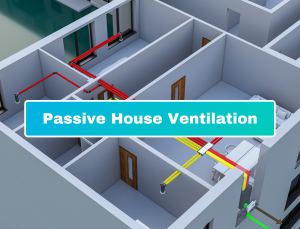
Applying the first 4 design principles will lead to a very well insulated building. The “problem” will then be that we are lacking a flow of fresh air. Opening the windows will not be a good solution as it will create major heat loss and will feel very uncomfortable for the occupants. The solution will be to include a mechanical ventilation system with heat recovery. Those systems transport the indoor air outside and simultaneously passing the heat from the inside to the incoming air flow. In this way, we get a constant supply of fresh air, no heat losses and high-quality filtration. This type of ventilation system has heat recovery efficiency rate of at least 75%.
I have made a video where the 5 Design Principles are explained. You can watch it here:

Passive House Certification of Buildings
Every building that meets the Passive House Criteria can become Certified. For this purpose, a Passive House Certifier must be included (as early as possible) in the project.
The certifier will then: Double check all files and calculations from the beginning, support the decision-making process, make sure that if the building is built as it is designed and that the building will perform in the way that the energy model shows.
In this article you can find the Fundamentals of Passive House Building Certification.
Certifying is not mandatory HOWEVER it ensures the achievement of the standard, guaranteeing clients get all associated benefits and confirming their investment’s worth, all while managing costs effectively.
If you have a project which you are interested in certifying, you can reach out to us here.
Examples of Passive House Buildings
Any building can be a Passive House. Despite the name, the concept is not limited to houses. There are numerous examples of Passive House principles being applied to new constructions and retrofits of single-family homes, skyscrapers ( “Curv” on the left), hotels (Hotel Marcel on the right) , schools, and more.


How to become an accredited Passive House Professional?
There are two ways you can become a Passive House Designer or Consultant:
Making an energy model in PHPP:
By completing an energy modelling in the Passive House Planning Package (PHPP) of a Passive House building that gets certified you can also obtain a certification yourself.
Passing the Passive House Exam:
Those are organized by the Passive House Institute itself and accredited trainers, such as the Passive House School. You can find more about the exam here.
To both get ready to pass the exam and to start designing Passive House buildings, I recommend following a Certified Passive House Designer/ Consultant course. You’ll discover comprehensive details on module content, schedule, and testimonials in this link